Saturday, June 22, 2013

Fishing on the Shoulders of Giants: Jerry Johnson


One of the pictures on my writing desk shows my son with a toothless little boy grin holding up his first brook trout with two hands.   The picture reminds me of a lot of what makes fly-fishing the passion that it is for many. Almost all it is a reminder of my first experiences trout fishing.
Some anglers know who inspired them to become a fly fisher.  
I was a convert to fishing by the “brothers” who practiced the art of angling with “garden hackle” for pan fish.   My first experience fishing was with cane but not the split variety:  one long, in the round, piece of bamboo, a long piece of black braided trolling line, a bobber, a sinker, and a hook.   So I suppose that those most responsible for my foundation in angling would have to be my father and grandfather.  If I had to identify a person most responsible for getting me “hooked” on the obsession of angling for brook trout, my Uncle Jerry would be the one who baptized me and forever left me bemused by the transparent mysteries of trout fishing. 


“Why did it always smell like worms when it rained?” I wondered as I waited by the front door of the building.  I watched the headlights arch over the guard railing of the highway turnoff hoping the next set would turn.  It was always dark, quiet and rainy when he came to pick me up for fishing, the just before sunrise dark.  You’d hear his car before you saw it, loud and powerful.  I’d just lost my front teeth; I was in the second or third grade.  We lived in a small basement apartment behind the International House of Pancakes off of County 81 just south of the Crystal Airport, in Crystal, Minnesota. 
A big engine and loud muffler would make the turn under the streetlight.  He’d pull up to the curb and the front passenger door would swing open.  Then the big voice would beckon me onto the front seat,  “Let’s go!” 
Thrown back against the seat we speed up to the corner and out onto County 81, tires barking at the turn.  No seat belts back then just hang on to the door handle and grab the edge of the seat.
We’d go to breakfast at one of those places where truckers, heavy machine operators, and construction workers would go to get coffee before they headed to work.  A place where everybody knew him by his first name,  “Hey, Jerry!”  He had a big smile and a big handshake.  He walked through the diner’s cigarette haze and got us a place at the counter.  Coffee and Old Spice and newspapers mixed with eggs and bacon and toast.  
We walked out to the rain-dappled car after breakfast and headed into the growing gray morning.  It always seemed to rain when we went fishing,  the foggy type of rain that wets the windshield but not enough to keep the wipers from squawking every other pass.

How many fishing stories start with the sentence:  He knew this place?  This is the mystique of any trout-fishing story, I suppose.  The more obscure, the more enigmatic.  So if I said a small sect of monks who hired my grandfather and uncle to do excavating work for them, in turn they were allowed to fish the small stream that wound its way throughout the monastery’s property, would it sound too incredible?  Would it be equally implausible to say that to this day no one else has fished this tiny freshet, this gush of secrets that is the spawning gravel of my fly-fishing life? 
 
I was nearly falling back to sleep when we turned off the main road onto an overgrown two track.  I was probably the best kid to take trout fishing because to this day I haven’t a clue where we went.
 Uncle Jerry threw me a key attached with a tarnished copper wire to a short piece of an old yardstick, the numbers fading into the weathered gray wood.  I’d seen the key hanging from the tag board over my grandfather’s workbench in his garage.  The gate in an old moss covered rock wall groaned with disuse as I walked it open. 
“Lock’er up behind me,” he called through the open window as he rolled the big car through.  The exhaust swirled out of the dual pipes and curled up over the bumpers, the brake lights turned it pink.  I stared at the wet rust stain my hands wondering how I’d be able to wipe them clean.  Grabbing a few fern fronds, I rolled them between my hands.  The explosion of that fresh scent of crushed fern filled the warm interior of the car as I closed the heavy door.  I hadn’t noticed it outside of the car; the smell of high-test gasoline exhaust over powered it.
“Hey, you know, I like that smell—ferns,” he said as a warm smile spreading across his face.  “It says were gonna’ catch some fish today!”   A over hanging limb of hazelnut bush plucked the antenna and turned my attention toward the thick cover and tree tangled covert that hid the creek.  The muffled throb of the engine as it was goosed to make a turn up into a parking spot along the two-track road said we had arrived.  I remember being so excited that I grabbed the crude cane pole that lay on the back seat pulled it through to the front seat backed out the open front door only to have it swing shut catching the front quarter of the pole.  Opening the door I discovered that I had crushed the tip.  The pole my uncle had told me he’d have rigged specially for our trip was wrecked.

He had said over the phone that he was making me a special pole for our trip, a smaller version of the one we used for fishing sunfish at the lake with Grandpa.  Instead of trolling line it had a fine monofilament line and a hook, no sinker.  “That’s because we want that worm to wash right down in that stream,” he expounded as we pulled out of parking lot after breakfast,  “like we just tossed it there for those brookies to eat.  Stinks slowly with just he hook,” he explained using his hand to indicate the worm just floating and fluttering along with the current.

“Hey, Stevie, that’s the beauty of these things,” he said taking the pole from my hand and pulling out a pocketknife.  “See here pal, you just cut the broken part off,” the knife cut through the thin cane tip clean.   He quickly nipped the line as well   and tied it back on the new end.  Handing it back to me, the hook stuck in the butt end, he said  “Be sure and watch out for the tip now when we walk by the brush, it gets tangled pretty easy.”  He winked and turned as he pulled his rod and creel from the trunk.
We walked an old grassy path toward the creek, under a canopy of hardwoods.  The stream snaked itself through a narrow grassy meadow where it disappeared into the woods again.  In the meadow, the stream was wide enough so you could step on the rocks and cross in a number of places.  The over hanging grass on the banks and the darkness of the water at the turns drew me towards the water.  My uncle’s hand steered me clear of walking through the grass to the bank.
“Hold on pal.  Save that water for me.  I’ll show you my secret spot,” he said, in almost reverent tones, stepping ahead of me on the trail. 
The creel bounced on his hip as we walked the trail out of the meadow and into the trees.  The stream flowed through moss-covered rocks that lined the banks with mixed hard woods creating a canopy.  Grasses and ferns hung heavy with rain near the water. 
“There will be a fish behind that boulder,” he said pointing his rod, “so remember to slip your worm off to the side of the rock and then let ‘er float around in behind.”
Farther up the trail we encountered a grove of old cedars whose heavy green foliage darken the path.  The water poured over a series of shallow ledges.  The trees had dug their roots into the limestone so that they appeared to grip the rock with great gnarled fingers.  We came to a pool at the base of a cliff where the stream poured from a narrow opening in the wall of limestone that rose above us.  The over hanging foliage at the top dripped rain water and the exposed rock wall seemed to weep, but it was the dark opening, the source of the tiny stream that amazed me and held me fast.  I watched as the silver tongue of flow as it entered the pool.  The hole created in the turbulence there darkened the water and gave the pool the appearance of a great eye.    

Jerry showed me how to the bait the hook:  “…hook the ring of the worm, not the way we tread the worm on for sunfish.”  He gave me the pole and told me to swing the worm over the hole and let it drop on top of “the tongue” coming from the rock… “That’s the only way you can catch ‘em is this hole.”  He told me to “… put ‘em in the creel, “ and pointed at the old wicker basket he left on a rock.  “There’s ferns in there already, but put some more on ‘em when you come down the trail,” he instructed.  “You ready? “ his question was as if we were about to embark on a quest of greatest consequence.
I accidently dropped the worm into the pool at my feet.  Looking up to see where my uncle had gone, I saw that he had turned around in the trail to watch.  Walking backwards, he called out, “The worm box is next to the creel.”  I set the pole down next to the pool and walked over to the rock.  The cut off milk carton with a hunk of moss as a cover sat next to the wicker creel.  When I got back to the pole, the line had swung down stream and the hook was bare. 
I baited the hook and attempted to swing the worm out over the pool and onto the tongue.  I came up short but allowed the worm to fall into the pool. A school of hungry minnows attacked the worm.  It reminded me of a scene in a Tarzan movie where Tarzan tricked the bad guy into swimming into a school of piranhas.  After another baiting, I put more effort into swinging the worm out over the pool and out onto “the tongue.”
I remember it took me awhile to get the timing right so that the worm landed on the tongue.  The sound of the water pouring into the pool, the movement of the water as it spread away of the roiling head, and the dark overcast seemed to have suspended time.  Perhaps it was my first encounter with what I have come to know as the many facets of “river time”:  the suspension of time, the loss of feeling for the passage of time, the “honey, I am sorry I am late, but I lost track of time.”
The worm disappeared into the opening in the rock only to reappear in an instant disappearing again into the whirling currents directly under the opening.  The line straightened immediately and bent the tip of the pole.  The throbbing of the pole as I lifted brought the trout twirling to the surface, out of the water, writhing on the end of the line as it swung toward me, only to drop off of the hook.
The darkly colored fish lay stunned at my feet.  I pounced with both hands and clung to the treasure. Then I was touched by it all.  The rich earthy aroma, a mixture of moss and wet soil and decaying leaves and bark, cool and clean and fresh and full—of blooming and growth, of vibrant expectation, of all that would come and came from the all cedars that dotted the banks of the all creeks, rivers and streams. From the wavering beds of watercress that seemed to glow with a deep mysterious vibrant green, a color that can only emerge from sounds of dripping water as it tumbles off of limb and leaf and falls to the grass and puddles on the banks, of the musical tune a spring run plays as it courses over and between rocks, of the voices that speak in whispered tones through the rush and push of a riffle, of the distance roll of a large rapids as it empties into a lake or pond or that silent sound of whorl in the current’s flow, spinning minutely, as a wide section of river sweeps by like a great movement of the earth’s mechanicals.  It was there in my hands in colors so rich and true.  The eye catching blue and red spots that speckle the flanks, the vermiculate patterns glowing a olive-yellow, the white on black fin markings, the orange and the olives of it skin, hiding an iridescence that reveals itself in just the right light, a light at the margins of our sight,  an iridescence that connects us somewhere beyond our conscious understanding, somewhere from the very beginning of the movement of water, the very beginning of flow, of life.  I still search for it in every brook trout I catch.   

I wanted Uncle Jerry to see it.  I carried it over to the creel and slid it through the square opening in the woven lid.  Picking up the worm box and pole, I headed back down the trail.   The air was thick with the scent of fresh rain and the distant rumbles of a storm.
When I got to the meadow, he was standing looking down the small stream that wound its way through and back into a tangle of alders and distant trees.  At his feet, two brook trout almost a big as mine, lay in the grass, gilled and gutted.  A flash of lightening in the distance drew my attention to the distant darkening sky.  He turned toward me, in his big hand a third fish, larger than the others.  The cut from anal fin to the gills a red line started to spill blood over his fingers.  The guts and gills came clean from the fish in one motion.  He knelt and washed his hands and the fish in the cold water of the stream.  I picked up all three fish and slid them through the hole in the cover, pulled more ferns and put them over the trout.  Uncle Jerry nodded and smiled at me and turned looking back up stream.
“Pretty, pretty ain’t it?”  Pretty wasn’t a word that I expected from my uncle, and I wasn’t sure if he was talking about the fish in the creel, the mist as it swirled in the breeze over the meadow, the pool and the rock wall, the stream as it flowed over the limestone, the cedars, or all of it.  Or maybe it was just that moment when you realize that it is all good, the being in that moment, truly there with the all of the senses receptive, mind cleared, soul wide open.

When we opened the creel at the car, my uncle lifted the largest fish from the wicker and ferns.  “That’s the one you caught, the best fish of the day,” he lied.  I didn’t know what to say.  I knew that it wasn’t my fish, so did he.  He smiled that infectious smile that you now see on the faces of all his sons.  He took a bottle of beer out of the trunk and popped the cap off and handed to me saying, “Just a sip now.”  I handed it back to him, and he winked at me, and I smiled a big toothless grin.
I rode all the way back to my Grandmother’s house with the smell of trout on my hands.  When we got there, we would be treated to an early dinner of fresh brook trout and fried potatoes.  I didn’t stop to fish that rock he told me about and never went back to fish that little mysterious creek--couldn’t find it if I wanted to.  I never fished with my Uncle Jerry again.  He recently passed away as do all trout anglers.  It would take me another decade to awaken the passion for fly-fishing and brook trout.  It has been over fifty years since the first time I had the smell of brook trout on my hands.

An old fishing partner of mine used to say that “trout fishermen come home late, smell of strong drink, and the truth is not them.”  I guess that may be true.  I know from time to time, when I see the white stripe on black fin or whiff a bit of brook trout on my hands, I smile and remember my Uncle Jerry, his secret place and my toothless grin.  It must have been as big a toothless grin as my son’s toothless little boy grin with his first brook trout.

Did I mention that I have three uncles… they’re all named Jerry?  It’s the truth!


Keep a tight line,


Steve

Tuesday, March 19, 2013

"waiting for the fall"

Damian Wilmot in a the mist on the Brule River, WI


everything falls sometime                                       
whether heading upstream moments before the crossing:         through the alder
a split cloud cover                                                                             canopy distraction
one side:         the unretractable gray ceiling                                             on this trail               
the other:       mare’s tails whipping across          
azure and hot white afternoon
sun rings radiating out                                                                    

or

crossing above the rock dam
shuffling between shin barking rocks                                            and the slime  
that turn all into stumbling drunks                                                covered ones
with rods held out for balance
against the press of current (can be reassuring)
past the edge of conformity and                                                    
comfort in the shadow
of a passing front 

or

the sudden sun wash of  light                                                         inlaying each wrinkle
in those places where                                                                      in the dark metal surface 
we send our self to silence                                                                           with silver foil 
where our souls sometimes come and go
where there are no human rights
and everyone is known as Nohbdy

                                                we fish
                                                we fish there
                                                with measured intent
stand in the shallows on the other side of the crossing
only to strip the sweater off and stuff it in the vest
                                                enjoy
                                                the cooling damp
in shirt sleeves
watch the young of the year dart about the wading boots
only to look up into the wavering clouds of Hendrickson spinners
                                                climb up
                                                the riffle
                                                at head height,  thick and shifting in their clumsy flight  
to dab at the surface, grasp at each other in their ephemeral moment
only to climb again, curled tail heavy with their pregant weight
each egg sack
translucent yellow glowing 
awakening dream scape of color and light
                                    on unsure footing waiting
                                    for the fall
                                    for the trout in their ficklness
                                    won’t rise                                           from their
but watch the mayfly dance                                                 silent
through their wrinkled silver windows                              lie                                                       

a collective refusal
of egg rich sexuality
and submissive protein

how long before staring into
this flight                                                                                            before time lost
                                                                                                            we’ve fallen into it


Keep a tight line,


Steve


Dave Lucca in the midst of a Hendrickson spinner fall

Tuesday, December 25, 2012

"It's coming on Christmas they're cutting down the trees..."

a few
 wisps of cotton white in
 slow float through the cherry red
 dogwood, sparkle
 in the sunlight
 that cracks this gray sky
 the vanguard of inches
 to come, long night’s sleep,
 bright white ski hill climb, and the dark
twist of ice exposed river muscle.

 we brought the tree down off the hillside
to the caroling of the chickadees 
and the mutterings of the nuthatches
and heard in the rise of the wind
out of the valley
 the river song and
the voices of all those
 that have sung this hymn with us
when we’ve gone to get the tree.
as the last chord is strung and we
turn onto the road north and home
the melody of Christmas scent
to come and those past
a stickiness on our hands
the reminder that the voices
in the branches’ redolence
is your song “…of joy and peace.”


Merry Christmas and a Joyous New Year

Hyvaa joulua Onnellista uutta vuotta

Keep a tight line,

Steve Therrien

Tuesday, February 14, 2012

From that which runs on

(for the woman that holds things together)

maples wait in the deepest cold to trickle
currents of obligation, from that which runs on
all others abide the mechanics of flow
once started in prime movement, still races to the sea
the side hill spring spills into
cascade, spate, and rush all from that which runs on
flux and wane, catalyst of consequent
fixed in the solution’s mix, merged element bound,
unfrozen, unyielding, loved
you


Happy Valentine's Day

Keep a tight line,

Steve Therrien

Monday, January 2, 2012

Sutton River Memoies

See previous posts about our trip to Hudson Bay.

Over time long trips into the wilderness evolve in our memories. The moment-by-moment experiences fade into key memorable stories that fix onto the memory of the trip with a number of episodes that become emblems of the whole experience. These are just a few stories that are those emblems.

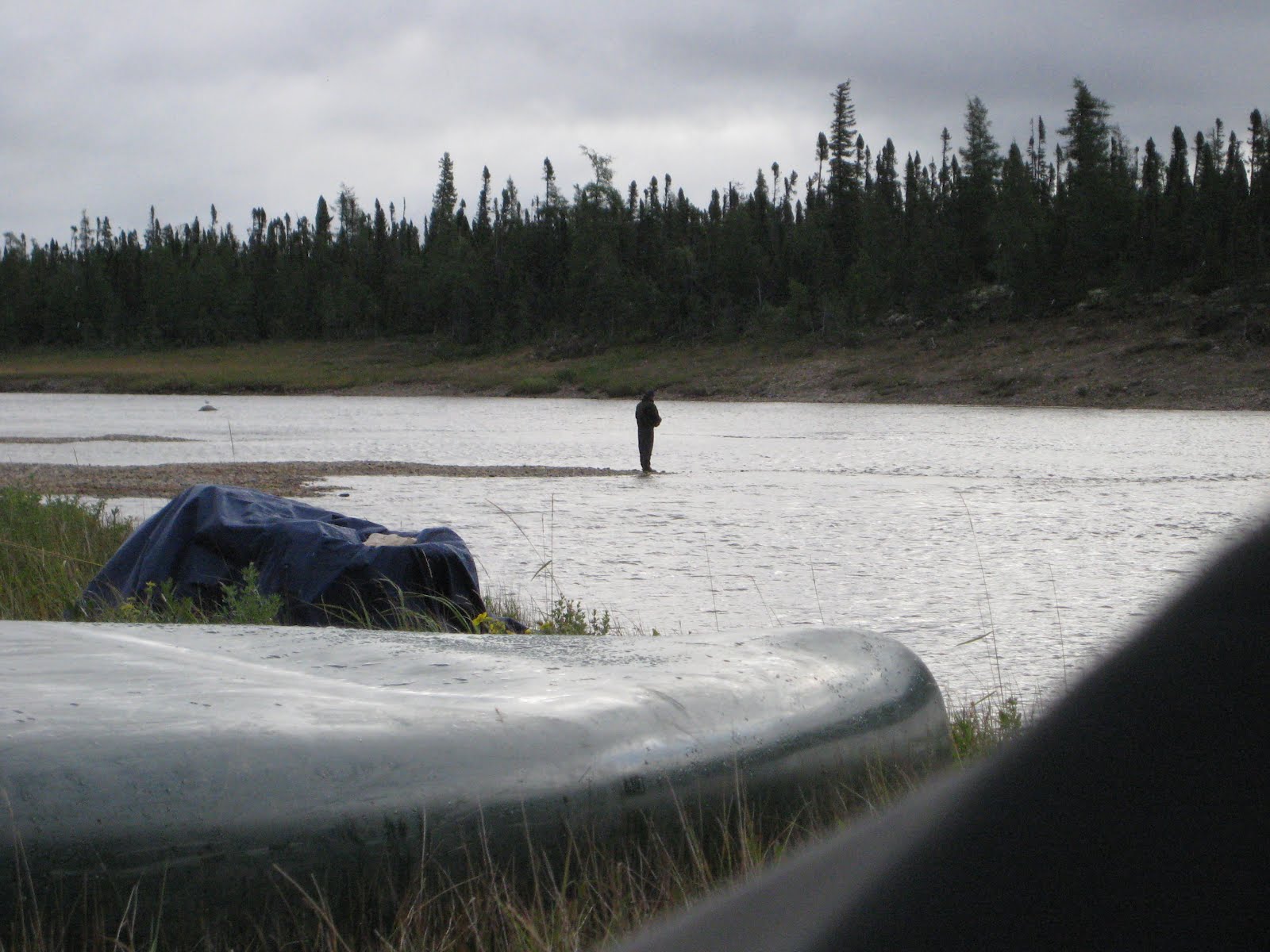
About a third of the way down river from Hawley Lake to Hudson Bay, the Sutton River starts a pattern that continues until it gains volume from the Aquatuk River, 30 miles before the river enters Hudson Bay. Rolling down gentle glides the Sutton will braid out into rocky shallows with long exposed gravel islands bordered by wide grass and willow covered high benches accented with stunted aspen.


Large bends in the river carve deep rocky turn holes that level out at the tail outs then empty out into deep bank runs opening up down river into a shallow braided channels. This pattern repeated itself for most of way until you encounter the confluence of the Aquatuk River. Though deep turn holes fished well, we found, as we progressed into this middle third of the trip, the long stretches of shallow water got longer and the turn holes held fewer and fewer fish. In this long shallow section we were forced to get out and walk the canoe through.The landscape of the Sutton River can arrest your gaze for minutes at a time. Beyond the spruce stands that lined the river, plains of sphagnum moss, Labrador tea, scrub willow and stunted aspen and spruce spread out to the horizon and beyond, a land of haunting beauty and transfixing solitude.


The volume gained by the addition of the flow from the Aquatuk increased the depth of the river so we didn’t have to get out and drag the boat across miles of shallow gravel runs. The quality fishing increased as well. We were forced to lay over for a day on a mile long section of the river where the main channel of the river flowed deep long the far bank of the river from where we chose our camp. All along this section numerous gravel bars had formed stretching from our side river out into the main channel giving us multiple access points to fish. Our lay over was not something we had planned, but a a change of plans when we woke to a mixture of wind and rain. We had built a lean-to shelter with our tarp quickly in the morning. After breakfast we decided not to move down river until the weather let up.
Charlie retired to his tent, and I sat under the trap to kick back. It soon dawned on me that was I sitting under a trap on the banks for a World-class brook trout fishery with bombproof waders and rain gear sitting out inches from my reach. I’ve fished my home waters of Northwestern Wisconsin in worse weather. Why would I past up the opportunity to fish now?
In short order I was geared up and walking out onto a gravel bar near where we watched a number of fish roll near the surface in the fading light the day before. Fingerless mitts, fleece, stocking cap, hood up and reefed down as not to catch the wind, I wondered whether Charlie had made the better decision of the day. The channel off the gravel bars waded easily and getting into position I wondered how would I make casts in the gusting winds. Looking up river you could see sheets of rain fly down stream on the gusts. Though the wind was sustained, there seemed to be pauses in the intensity that would allow me to try a cast. My back to the wind, which came directly down river, forced me to cast primary across and down. The sink tip line I was using didn’t cast well in the wind, but it was perfect for getting the streamer into the water column.
Waiting for a opening in the wind, I stripped out line and prepared for a short cast. When my opening came, I back cast once and let line out on the first false cast. The next gust flatten my back cast just as I came forward with the rod causing my fly to bounce off my hood with a loud thwack, right next to my ear lobe. The wind carried the line and unfurled it out over the river. I watched the fly settle into the clear water. In the over cast light and broken surface, I could still see the fly scoot along as it swung in the current just above the gravel and rocks.
Immediately three dark forms chased and darted at the fly. As soon as I gave the it a short strip, one of the dark forms struck so hard that the #2 Zoo Cougar set solidly. Turning down stream, the fish pulled the few feet of slack I held loosely against the cork straight through the stripping guide. It was hooked and on the reel taking out line before I could raise the tip. I walked and fought the fish into the calmer warm below the gravel bar. Earlier in the trip, we started using 12-pound test tippets so that we could play the fish quickly and release them.
Very few casts came up empty. I found that using a water haul and immediately punching out line was the most effective cast I could make. Fighting the wind with a 9 ½ foot rod can wear an arm out quickly. Fighting brook trout, both native and sea-run ranging from 2-4 pounds, can add to the fatigue of a casting arm. Every strike was aggressive and the fish chased the fly from great distances, sometimes taking the fly just as I was about to pickup and cast.
As I released fish number 38, Charlie emerged from his tent and shouted, “How many?” He couldn’t hear my reply through the wind. I needed to put on a fresh Zoo Cougar, so I set my rod down on the gravel bar and stood with my hands in the air and flashed him 3 sets of 10 fingers and then held up eight.
“Thirty-eight?”
I nodded.”
“Jesus!” he shouted and ran for his waders.
While tying the fly on, I realized how fatigued and cold my hands were. I watched my hands move through the tying ritual as though they belonged to someone else, someone much older. Even though it took much more time to tie on a fresh fly than
usual, I still caught two more fish before Charlie reached the end of gravel bar.

The wind and the rain passed and the sun poked through just just as the sun set. We woke the next morning to clear blue skies, warm temperatures and no wind.

River travel sets a rhythm unique to each body of water. The Sutton’s flow a steady sweep down stream established leisurely pace. As with all wilderness trips camp life sets patterns: looking for a camp, setting camp, breaking camp, and travel. When the patterns and the pace feel routine, one should be mindful that all rivers are changing environments. Breaks in the pattern such as sudden change in the weather and the need to adjust the travel routine to meet the changes the river presents keeps the river traveler alert. It is too easy to get lulled into a sense of security when everything is going well.

We had traveled the river for nine days and where close to where the river transitioned from the Hudson Bay Lowlands to the Barrens of Hudson Bay, a region before you get to tidal flats of the Bay that is considered tundra. Tundra below the Artic Circle is rare. Seeing this unique corner of the world was a primary reason for our trip. Stopping on a rock bar at the end of a wide turn of the Sutton, we broke out the lunch bag and made sandwiches. The bank of the river was about waist high. With the cutting board set in the grass, we cut bread, cheese, and hard smoked sausages. Fishing had been fairly slow for most of the morning and so we were in no hurry to fish the tail out of the turn after lunch.

Across river a caribou came out of the tree line and moved cautiously out onto the bench. Winnowing the air and slowly grazing, it moved down river towards us. Moments later it broken into a run down river. Something must have caught its attention.


We had seen one other caribou a day before. As we watched the caribou disappear around the bend in the river, we both remarked about how few larger animals we had seen on the trip. Shore birds, ducks, eagles and ospreys were common throughout the trip. Returning to the cutting board to cut a an energy bar in half, I was immediately distracted by a snort from the brush forty feet up the high water mark near the tree line.

The sight of a polar bear sticking its head through the trees does not register immediately in one’s brain as a threat. I think we are all conditioned to believe that polar bears live on the pack ice, the frozen tundra, generally places where they look like they belong. White animals on green backgrounds generally doens’t usually give one the impression that they “belong.”

Charlie and I were both slow on the up take, which is not a good reaction to the situation we found ourselves. The largest land predator in North America, one that can run full speed carrying a seal the size of a NFL linebacker in its mouth, should get the warning siren screaming in your brain. But it didn’t. The only thing running through my brain was that we needed to get this bear away from us or we needed to be prepared to kill it. The third possibility was not an option a far as we were both concerned.

We had brought a 12 gauge shotgun, an air horn, and flares all in the event that we would encounter a polar bear. The gun was the only thing we had readily available.
Fortunately, the polar bear didn’t charge immediately. This gave us the time to get to the canoe and uncase the shotgun. Moving closer to us, the bear nosed the air as he approached. I told Charlie to shoot over the bear’s head. The first two loads in the gun where buck shot. Shots three through five, slugs.

“Before I shoot, take a picture,” Charlie said handing me his camera. Point and shoot digital cameras work great in these situations because you can literally, one-handed, point and shoot. While stuffing the camera into Charlie’s jacket pocket, Charlie aimed and shot over the bear’s head. It had little effect on the bear’s progress. Jumping up and down, waving my arms, and shouting profanity had worked on a curious black bear once, but had little effect on the polar bear as it continued to approach. I hurled rocks and continued to hurl insults as well. Most of the rocks fell short of the mark because their size made them far heftier than my ability to pitch them.


The second shot had no more effect on the progress of the bear than the first. I continued to throw rocks as fast as I could find them and heave them. At about thirty feet, a softball size rock hit the bear between the eyes. The lucky toss sounded like a rock bouncing off a coconut. The bear wheeled around and ran into the trees. We wasted little time getting the canoe off the rock bar and down river.

We didn’t stop paddling until we were miles down stream. Even though we put miles between us and the bear, we both where constantly glancing back up stream checking for a white form on a green background. For the rest of the trip, our awareness that we were a part of the food chain sat a little farther forward in our attention.


Close to its mouth the Sutton gains even more volume from its tributaries. We encountered massive turn holes and long deep straights. Some of the turns were lined by huge eskers, evidence of the massive power of the Sutton during its spring ice out. The scars on the trees along the tree line throughout the trip were further evidence that this gentle river when in spring flood sheds a massive amount of water and with monstrous chunks of ice.

The Sutton widens out as it flows through an area referred to as the Barrens—tundra below the Arctic Circle--an almost treeless landscape of mesmerizing beauty. With two days on the river remaining, we picked a camp on a long wide section that had a commanding view both upstream and down.


Throughout our trip we used various mice patterns to fish to rising trout. The most effective pattern for us was the Morrish Mouse. Fishing the mouse dead drift was far more effective than waking the mouse through the surface film. Waking the fly usually got the fish to follow the fly; letting the fly float and drift down stream brought on the most aggressive strikes.

Fishing to rising brook trout has to be one of the stream fishers greatest joys. Fishing to brook trout 18 inches and larger, with dead drifted mice, indescribably delightful. Charlie and I spent our last evening on the river catching brook trout on the surface well past sunset. We truly lost track of time.

We cooked our last dinner on the river in the dark sharing the last of our bourbon and rerunning the incredible sight of brook trout heads rising out of the water to scoop in mice. Sleep came easily that night. I no longer dreamed the dreams of the other dreamers.


Last day on the river


See the previous post about the trip to Hudson Bay.

Keep a tight line,

Steve Therrien

Saturday, July 23, 2011

You'd Have to Be Nuts to Put up with That


“Much Madness is divinest Sense -
To a discerning Eye…” Emily Dickenson


“I don’t start fishing until the air temperatures are in the sixties and the frost is out of the ground,” he said looking over his tying glasses and tying vise. “You guys that go out in that early season are just nuts!” He raised his hand with index finger pointed at the ceiling for emphasis and to keep me from responding “I know you catch fish, but you know, if a guy has to go out and drag his ass through the water when the ice isn’t off the banks then I guess the fish will just have wait for me, because it isn’t my cup of tea.”
What’s to argue there? By their very nature fly anglers are a different breed. Some of us really do go to the extremes. Destination fishing has proven that. Fly-fishing for Tamen in Mongolia or River Dorado in Brazil take the angler to the extremes of travel, and the target fish of the trip sound other worldly compared to the brook trout and brown trout found on my home river. Let’s not even talk about tackle and methods because we push the limits there as well.
So, I go out and fish the early season and get a little cold. In these cases, the rewards are always personal. For me, skiing is just about done, and the opportunity to get out and fish relieves a little of the house bound feeling that accumulates over the course of our long northern winters.
I am always rewarded. Getting out to see how the rivers have wintered over, affords me the time to reacquaint myself with the waters we fish and to get to know the river at a time of the year when it is waking from the sleep of winter. Wading through sections of the river in the early season helps to spot springs that may not be visible at any other time of the season. This in turn may give the angler clues as to where trout might hold when the water warms later in the season. Spawning areas can be seen by the clean spots worn in the river gravel that might indicate the success of the years spawning run.
The river’s barren appearance, akin to the skeletal look of the woods before spring’s green push, has its own beauty. The angler can see the shape of the bottom more clearly. Underwater cover visible in the early season may be hidden by weed growth in early June.
The light at that time of year has a different intensity. When it is bright, it is remarkably clear and blinding. When there is a slight overcast, the diffuse light can be surreal as it to bounces off of the snow in the woods producing an almost shadow less world. A more pragmatic reason for angling in the early season when the leaves are down and a hard snow pack is still in the woods may be that getting to some of the remote sections of stream is easier without the summer growth of the under story.
The fish target the few hatches of insects that are active during this time. If the water temperature warms enough, trout will pursue smaller fish especially the big brown trout. Though the fishing strategies are narrow in focus, they are not as complex as a river in full bloom. Anglers still have to be careful of their presentation and approach to the fish.
However, trout will eat just about anything they sense as food. A few years back my fishing partner and I watched a sizable brown trout vomit a desiccated bullfrog just before we released it. We wondered about how the fish got a hold of a large frog at that time of the season. A year later at about the same time of the early season we watched as a dead bullfrog tumbled down stream on the bottom of the same river.


I recognize that the weather can eat into your reserve of tolerance. Trout do not always go for what is put on the table. Patience can be replaced by a deep need to get back to a warm truck, to drink hot tea and to drive thinking of the waiting sauna. What keeps me coming back during the early season is how very elemental this part of the season can be. The black-capped chickadees have started their summer songs. The little black stoneflies crawl out onto the snow and ice covered banks. The geese are moving north. Large sheets of ice float down stream oblivious to all things they encounter. Things are moving along the river.


We’ll catch fish. The first pulsating lunge of the rod since the close of the season is the reward for waiting through a long winter: the reassurance that the river and its fish made it through another cycle. The season’s turn comes just as the days get a bit longer and the sun a little higher. It’s warmth a balm easily soaked in on a bright March day. Those of us that are crazy enough to go out know why we are out there. We all are surprised at what we find. The beauty of a cedar bough, ice coated, as it bobs into the current and out. The grace in a brace of trumpter swans as they grab air to get into the blinding blue sky. Sometimes we’ll be surprised at the bright flash on the bottom that stops the fly in its mid-current swing. The dark shape takes off in a rod-hammering run down stream. The iridescent golden shine in the bright spring sun surprisingly vivid after being play in mid-stream. I guess you’d have to be nuts to put up with that.